Pricing
PrestaShop Pricing Across Classic Hosted and Store Operations
Compare PrestaShop Classic free download versus Hosted €290 annual invoice, with support scope, module renewals, and processing fees separated from platform cost.

PrestaShop pricing starts with two decisions: run the free Classic download on hosting you choose, or pay for Hosted so PrestaShop handles hosting and support. Hosted's actual annual invoice is €290 excluding VAT, not the advertised €24/month figure. Classic permits module and code customization but brings upgrade, backup, and compatibility duties. Hosted bundles hosting, installation, and six-day-a-week support by email, chat, and phone. Neither route is automatically cheaper; service scope decides.
From my perspective, the matched hosting costs are too close to decide by sticker price. I would choose Classic when you or a contracted maintainer can handle upkeep and want meaningful control over code and hosting. I would choose Hosted if its included services genuinely replace work your team does, not just convenience extras. My main reservation concerns module and upgrade scope: confirm which updates and compatibility fixes are covered before relying on them. Official sources were checked in October 2026; community accounts remain anecdotal.
What Classic and Hosted actually charge
PrestaShop’s offers page separates Classic and Hosted; the Enterprise URL redirects to that overview. Classic’s download is free and open source, but that covers only software. You arrange hosting, choose a domain, and own maintenance, compatibility, and customization. A zero license fee is not zero cash outlay.
Hosted bundles software, hosting, and installation with support six days a week by email, chat, or phone. The offer lists €29 per month excluding VAT on monthly billing. The annual plan displays €24 per month, but its explicit invoice is €290 excluding VAT for one year, about €24.17 monthly. Budget from the invoice, not from a rounded display.
| Plan | Price | What you pay for |
|---|---|---|
| Classic | Free download; hosting/domain separate | Software and customization freedom; you handle hosting, maintenance, compatibility |
| Hosted month-to-month | €29 ex VAT per month | Hosting, installation, support, billed monthly |
| Hosted annual | €290 ex VAT per year, billed once (€24.17/month equivalent) | Same Hosted scope on an annual commitment |
| Enterprise | No verified public price from this source | Larger deployments: verify current terms directly |
Enterprise is not a public quote. The Enterprise URL currently redirects to the general offers overview, so a larger deployment’s current price and inclusion must be scoped with PrestaShop directly. Do not read price details into the redirect.
All shown prices exclude VAT. Whether, how, and at what rate VAT applies depends on the merchant’s jurisdiction and registration, so do not assume one extra charge for all buyers.
Hosted’s plan covers hosting and support, but included services and modules do not make transaction, advertising, or shipping usage free, and it makes no universal regulatory compliance promise. If those usages go beyond the plan, the total bill can rise outside the headline price. Classic leaves you arranging those costs directly, at the price of carrying the maintenance work yourself.

Included services replace only part of the budget
Hosted's invoice covers a named scope: hosting, installation, support six days a week by email, chat, or phone, and 50 GB storage on a PrestaShop 8-based plan. The Hosted offer page states those items, and the Classic page cross-sells Hosted with technical help, updates, and essential modules. That defined coverage can replace a hosting bill and some system work you would run under Classic. The practical question is which tasks fall outside the definition.
That boundary also governs the "modules included" line. A bundled checkout module is software; the payment processor behind it still charges per transaction. An advertising module does not finance media. A shipping integration does not pay for labels. The Hosted page itself notes that included services and modules do not make transaction, advertising, or shipping usage free. Those costs follow sales volume, payment country, and processor terms, not the platform plan.
| Budget line | Under Hosted |
|---|---|
| Hosting, installation, 50 GB storage | Included in the annual invoice |
| Support by email/chat/phone | Included, six days a week |
| Payment processing fees | Separate, charged by your processor |
| Advertising media | Separate, you fund campaigns |
| Shipping labels | Separate, you pay postage |
For a fair baseline, keep payment processing, advertising, shipping labels, and modules beyond the included set in both columns. Remove hosting from the Hosted column only because it sits inside the invoice. Counting bundled features as if they erased processing or media costs would understate Hosted.
A 2025 PrestaShop forum thread illustrates the residual work. The operator of a very large catalog solved an immediate product-page problem by removing two related/recently-viewed modules. That is one individual debugging report, not a capacity benchmark, but it shows module-level upkeep can affect store performance. Because Hosted's included support is not documented to cover every third-party or custom-module case, weigh module upkeep in both options.
The value then depends on where your costs sit. Hosted may remove a hosting contract and the operational hours tied to keeping that server running, but only when those hours fall inside the included scope. A store whose costs sit mostly in payment fees and ad traffic sees little change here. Treat the 50 GB allowance as a capacity bound, not an unlimited scale promise.
A cost formula for comparable store proposals
Use one formula to separate what every store pays from what the platform choice changes. Common costs cover domain renewal, module licenses, payment processing, and store labor that stay the same under either route. Add the platform-specific line on top. Classic is a free download, so its total is common costs plus hosting plus any operations you perform because no provider maintains the server. Hosted invoices €290 annually for hosting and support, so its total is common costs plus that invoice plus any Hosted-only operations. Common costs appear on both sides and cancel when you subtract one total from the other. The decision reduces to hosting and operational scope, not the full store budget.
Apply that formula with consistent requirements. Keep the feature set, module list, processor mix, and traffic volume identical in both columns. If you add a faster server to Classic or an abandoned-cart module to Hosted, you are comparing different stores. That does not mean service prices must match. A hosting contract you select may cost more or less than Hosted's invoice; record that as a legitimate price difference. The relevant rule is that both columns cover the same required work.
Scope the extras. Hosted's support replaces labor only if the tasks you would otherwise pay for sit inside its included services. Verify that before setting Hosted-only operations to zero. Labor estimates are assumptions, not benchmarks. State planned hours explicitly so the comparison stays testable. One support hour at €40 costs €40. Budgeting that hour monthly yields a €480 annual line, which is 12 hours of support per year, not one. That unit distinction matters when comparing platforms: the choice should turn on which work you can hand off, not on a small hosting-price difference.
Two store budgets with matched requirements
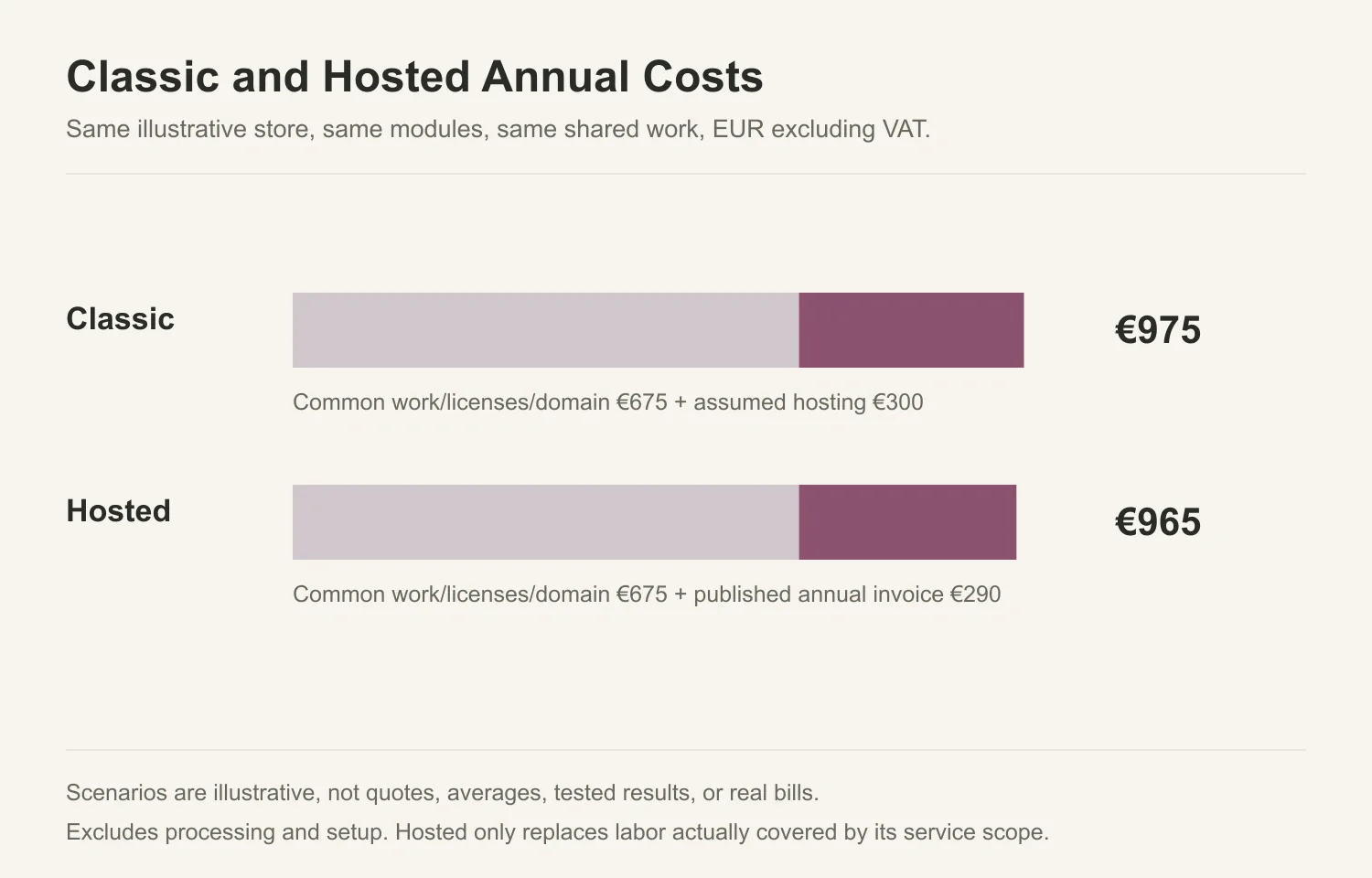
The comparison works only when both columns describe the same hypothetical store: the same domain, module set, shared catalog work, processor mix, and traffic, differing only in the platform line. Classic pays a separate hosting contract; Hosted carries its annual invoice. The labor hours are stated assumptions, not supplier quotes. Figures are euros excluding VAT; recurring lines are per year, setup is one-time.
| Annual budget line | Classic | Hosted |
|---|---|---|
| Domain renewal | €15 | €15 |
| Module renewals | €180 | €180 |
| Shared catalog/module work (12 h at €40/h) | €480 | €480 |
| Common subtotal | €675 | €675 |
| Classic hosting (€25 × 12) | €300 | Not applicable |
| Hosted annual invoice | Not applicable | €290 |
| Recurring subtotal before processing | €975 | €965 |
| One-time setup | €600 | €600 |
| First-year subtotal before processing | €1,575 | €1,565 |
The Hosted offers page invoices €290 excluding VAT for the annual plan, not the rounded €24/month display. The Classic page keeps the download free and leaves hosting and domain costs to you. With hosting estimated at €25/month, the recurring totals land €10 apart. At the assumed €40/hour rate, the €10 gap is fifteen minutes of labor, so it sits inside the uncertainty of the model itself. The €10 cannot justify choosing one operating model over the other; the decision rests on which work and renewal terms you can verify.
Variant B adds a Classic-only line. If the store needs six extra hours of infrastructure work per year that Hosted's included support would cover, at €40/hour, Classic rises by €240 to €1,215 while Hosted stays at €965. That €240 is conditional: it holds only when the Hosted plan truly replaces that specific work, and if the six hours go to custom module development or code outside Hosted support, they belong in the Hosted column too, returning the spread to €10. I would subtract it only after confirming the task sits inside Hosted's declared scope.
Setup is €600 in both columns, so the first-year totals mirror the recurring spread: €1,575 versus €1,565, and €1,815 versus €1,565 after variant B. In baseline scenario A, changing a shared cost equally in both columns leaves the €10 gap unchanged; in variant B, the Classic-only hours are one-sided, so changing their hourly rate changes the €250 gap. The ranking can flip only on costs one column bears alone: Classic-only infrastructure hours, a required module outside Hosted's included set, the hosting price, or a service Hosted actually replaces. Judge the budgets as equal until a verified scope difference appears, then reprice exactly that one line.
Labor and module renewals can outweigh the plan gap
A €10 gap is not a buying signal, and any cost that hits both columns equally leaves the comparison unchanged. The decisive change is one that lands on a single side. One added hour per month at €40/hour adds €480 to either total. If that hour falls on Classic only, the spread becomes €490 in Hosted’s favor; if it falls on Hosted only, Classic becomes €470 cheaper. A planned support hour can dominate the hosting-price difference.
Module lines work the same way. If both stores need the same module, adding it on both sides cancels. Crediting Hosted with a module saving makes sense only when an included module replaces a module you would otherwise buy under Classic. If the module is unnecessary or free in both routes, there is no saving.
Older community accounts make the same point in practice. A September 2023 r/selfhosted report from a four-plus-year PrestaShop user praised routine use but disliked yearly marketplace payments for themes and modules. A 2024 reply liked the admin and add-ons but reported upgrade hassle and an unsatisfactory module/refund experience ending in account credit. These are self-reports, not current product tests; they do not prove current refund policy. They do make module selection and renewal terms a cost to verify before you commit.
The Business Care terms are part of that verification. For applicable Marketplace purchases, Business Care is billed annually at 40% of the module/theme price on the first payment or automatic renewal. Since 20 March 2025, reactivating a lapsed subscription costs the subscription price plus 95% of the module/theme-alone price. That is a reactivation fee, not a 95% annual renewal; it does not apply to every module or imply a lapse stops your store.
The €180 module-renewal line in the matched budget is a stated assumption for equal module needs, not a Business Care calculation. I would verify which required modules carry Business Care subscriptions before treating that line as stable.
| Change | Effect on total | Relative result |
|---|---|---|
| Extra 1 h/month labor to both stores | +€480 each | Gap unchanged |
| Extra 1 h/month labor to Classic only | +€480 to Classic | Hosted cheaper by €490 |
| Extra 1 h/month labor to Hosted only | +€480 to Hosted | Classic cheaper by €470 |
| Extra €100/year module to both stores | +€100 each | Gap unchanged |
| Hosted bundles a €100/year module Classic would buy | −€100 to Hosted | Hosted cheaper by €110 |
The table shows those moves: a matching labor or module addition leaves the relative gap alone, while a one-sided labor hour or a Hosted-included module that Classic would buy changes the result.
Release differences belong in implementation quotes
The Classic offer page points to PrestaShop 9.2, while the Hosted offer page describes a plan based on PrestaShop 8. Version support differs by release: the system requirements documentation lists PHP extensions and database/server specifications that vary across PrestaShop versions, including a recommended minimum 512 MB per-script memory. A quote may cite requirements that do not match the deployed software. That does not mean compatibility always fails, but it makes the scope inaccurate and can hide needed work or show unneeded constraints.
Record the exact PrestaShop version for every environment and pair it with the matching version of the official requirements. Quote for the release you intend to deploy and name that release explicitly. A module built for 8 may need adaptation on 9.2, and one written for 9 may expect a higher PHP version than your 8-based hosting provides. Neither outcome is automatic; compatibility claims are meaningful only against the precise release named in the quote.
A 2026 French-language forum thread on migrating a long-lived 1.6 store illustrates why. One merchant reported difficulty with a migration module and substantial custom work; a later reply considered a fresh 9 rebuild defensible during internal redevelopment while stressing third-party module availability. This is community advice, not proof that either release is safer. Release transitions carry store-specific custom work and module checks.
Name the release path in the quote and put one-time adaptation as its own line. Upgrading an existing store, re-testing modules, or migrating custom overrides after a release change is implementation work, not a recurring platform or module fee. This keeps the one-time cost visible and lets you compare Classic and Hosted without shifting migration costs into a running total.
Payment volume is separate from the platform choice
Payment processing runs parallel to either PrestaShop route. Classic leaves hosting to you; Hosted folds hosting into its €290 annual invoice. Neither arrangement pays your processor. The fee total follows your sales volume, the payment methods you accept, the country where a card is issued, and the contract you sign with your acquiring bank.
Assume €10,000 of eligible monthly volume across 200 orders, with a generic processor charging 1.5% plus €0.25 per order. That is €150 in percentage fees plus €50 in fixed fees: €200 per month, €2,400 per year. This is an illustrative processor assumption, not a PrestaShop quote; your rate comes from your merchant account.
| Annual line | Classic | Hosted |
|---|---|---|
| Recurring subtotal before processing (scenario A) | €975 | €965 |
| Illustrative processing fees | €2,400 | €2,400 |
| Recurring total with processing | €3,375 | €3,365 |
Because the same assumption appears in both columns, the €10 gap between Classic and Hosted survives. In this scenario, processing is the largest single line in the budget, and a half-percentage-point swing on €10,000 of monthly volume is €600 a year, sixty times the gap. Your effective rate, any monthly minimum, and refund handling therefore outweigh the €10 platform difference. That weighting is scenario-specific; at lower volumes, the processing share shrinks.
Bundled checkout modules are software, not proof of cheaper transactions. Their inclusion does not establish that processing, postage, or advertising media become free or discounted. Those rates come from your processor, carrier, and ad platform, and they change with volume, country, and contract terms. The Hosted offers page lists hosting, installation, and support inside its annual invoice; variable usage rates remain separate.
Refund terms vary by processor and country, and those terms belong in the processor contract, not the PrestaShop invoice. When a representative emphasizes included modules, ask precisely what the bundle covers and what stays variable. Transaction processing is normally the latter.
Compare first year and renewal year totals
The table separates the one-time setup from the ongoing operation under the same scenario A assumptions. First-year totals include the €600 setup; renewal-year totals do not. With processing held constant, Classic is €3,975 and Hosted €3,965. That €10 difference is not a recommendation. It exists only because every shared input cancels, so the platform choice must turn on costs that do not cancel.
| Period | Classic | Hosted |
|---|---|---|
| First year (with setup and processing) | €3,975 | €3,965 |
| Renewal year (recurring with processing) | €3,375 | €3,365 |
| Setup portion | €600 | €600 |
*All figures EUR ex VAT; processing, volume, rates, and scope are held constant for this illustration.*
The renewal-year total is the honest running cost for an established store. For a launch, the first-year total estimates the first twelve months, not cash due before the first sale. Compare like periods: setting Classic’s first year against Hosted’s renewal hides the €600 setup and makes Hosted look cheaper than it runs. Timing still differs inside those totals: Hosted’s annual offer invoices €290 once for the year, while the Classic column assumes a €25 monthly host bill. A merchant on a tight month might prefer the smaller monthly outlay even though the yearly totals are nearly identical.
Shared renewal items, including Business Care on any applicable Marketplace purchase, add the same annual fee to both options when the module list is identical. That raises the total budget, but it cancels from the platform comparison, so it cannot make one option cheaper than the other. Only one-sided costs can reverse the ranking: Classic’s self-managed labor and hosting choices versus Hosted’s bundled support and managed services.
The €10 spread should not pick the platform. Choose Hosted when its included support demonstrably covers the operational hours in your budget. Choose Classic when you intend to buy those hours separately regardless. Before settling, confirm which required modules carry Business Care, and treat that renewal as a budget item, not a tie-breaker.
Related reading
- PrestaShop review: which store profiles fit Classic versus Hosted
- Shopify pricing breakdown: how Shopify structures plans and processing
- WooCommerce pricing breakdown: cost components and renewal behavior