Review
BigCommerce Review for Teams Comparing Hosted Commerce Platforms
BigCommerce review for teams compares hosted plan tiers, GMV caps, open-provider fees, Multi-Storefront, and B2B Edition from official docs through October 2026.

BigCommerce is a strong fit when Multi-Storefront or B2B Edition solves a valuable operational requirement. Multi-Storefront allows separate brands to run from one backend with per-storefront configuration, which genuinely simplifies multi-brand operations. The B2B buyer portal covers quotes, invoices, and company users, making it practical for wholesale teams. For a straightforward single-store business, though, I would weigh plan caps more heavily than these advanced features.
Pricing is my main reservation. Scale includes a monthly GMV overage and an Open Provider fee on top of the base plan, so revenue growth can raise costs beyond the headline rate in the published schedule. Also confirm that B2B Edition is entitled on your chosen plan; it is not a default across every tier. These conclusions rely on BigCommerce's official documentation as of 20 October 2026, not on hands-on testing.
Verdict for retail wholesale and multiple storefronts
| Team | Fit | Deciding factor | Watchpoint |
|---|---|---|---|
| Standard retailer | Core, Growth, or Scale | Expected TTM GMV | Caps alone do not decide; support and add-on terms matter |
| Multiple storefronts | Multi-Storefront | One backend, separate storefronts | Licensing and configuration scope need confirmation |
| B2B workflow | B2B Edition Buyer Portal | Quotes, invoices, company users | Confirm the plan includes the edition |
| Volatile revenue | Model before choosing | Peak-month overage and provider fees | Annual billing does not remove them |
The table summarizes fits, but the deciding factors are what matter. Core and Growth fit depends on your expected TTM GMV; Scale is worth quoting if you expect to pass the Growth cap soon. None of these features apply by default, so confirm which edition and how many storefronts your contract includes before planning around them. See BigCommerce's pricing page, the Multi-Storefront overview, and the B2B Edition buyer portal overview.
Revenue-volatile merchants should model a peak month, because Scale overage and open-provider fees depend on monthly GMV and the processor used, and annual billing does not remove them. The 2026 plan pricing update explains the current formula.
Community evidence belongs in that fit calculation, not in the feature comparison. One merchant reported being happy with the platform and its initial migration, then left after pricing changes, and the same user repeated that view in a follow-up: July 2026 migration report and same-user follow-up. That is a single self-report, not a representative result, but it shows billing fit can outweigh product satisfaction.
What the hosted platform includes
BigCommerce lists coupon and discount tools, gift cards, product ratings and reviews, reporting, real-time shipping quotes, and a built-in blog as included on Core, Growth, Scale, and Performance BigCommerce pricing. That gives you a useful baseline: standard merchandising and review features are part of the subscription, not separate app contracts. Many stores will still want add-ons, but you can start the cost comparison from this list.
Included means the capability exists, not that setup is complete. Real-time shipping quotes depend on carrier accounts and rates you configure; the platform has nothing to quote until that connection is in place. Reporting covers standard sales and order views, but it does not guarantee every custom report or finance export is included. Treat the list as a floor, not a ceiling.
Product ratings and reviews are worth checking against your category before you rely on them. A native reviews feature does not mean every specialized workflow is covered. If you need moderated Q&A, photo or video reviews, or syndication to external channels, verify whether the built-in tool handles those or whether a separate service will be required.
Hosting is also separate from integration ownership. BigCommerce runs the managed storefront and checkout, but its open/integrated positioning does not make it the operator of your payment processors, carriers, or ERP and PIM systems BigCommerce. You remain responsible for onboarding those connections and for mapping products and customers during migration. The platform does not do the cleanup work around them.
Payment processing belongs in the same cost model. The plan-update page documents provider-fee mechanics separately, with rates tied to plan and processor plan-pricing-updates-2026. Fees are plan-dependent and processor-dependent, so no plan assumes them away. Compare processing costs alongside the native features above rather than treating transaction fees as a fixed extra.
Multi Storefront changes how brands share operations
A single BigCommerce backend can serve multiple storefronts, each with its own themes, widgets, scripts, social links, pages, default currency, emails, subscriber management, and product filtering Multi-Storefront overview. The real benefit is shared administration, letting teams run several brands without separate admin logins. For a simple one-brand store, this is not a reason to choose BigCommerce.
Documented behavior is storefront-level control, not automatic catalog isolation. Product filtering settings are shopper-facing facets, not proof that a product is restricted to one brand. If brand separation requires unique catalogs, confirm that behavior in your contract before rollout. Shared reporting also does not create separate legal entities.
Commercial scope is not fully public. The cited overview is not a complete quote for this configuration. Ask how many storefronts your plan allows and include that answer in your cost model alongside the BigCommerce pricing analysis. If licensing is flexible, multi-brand teams benefit; if not, that cost may outweigh the shared backend.
B2B Edition goes beyond a wholesale discount
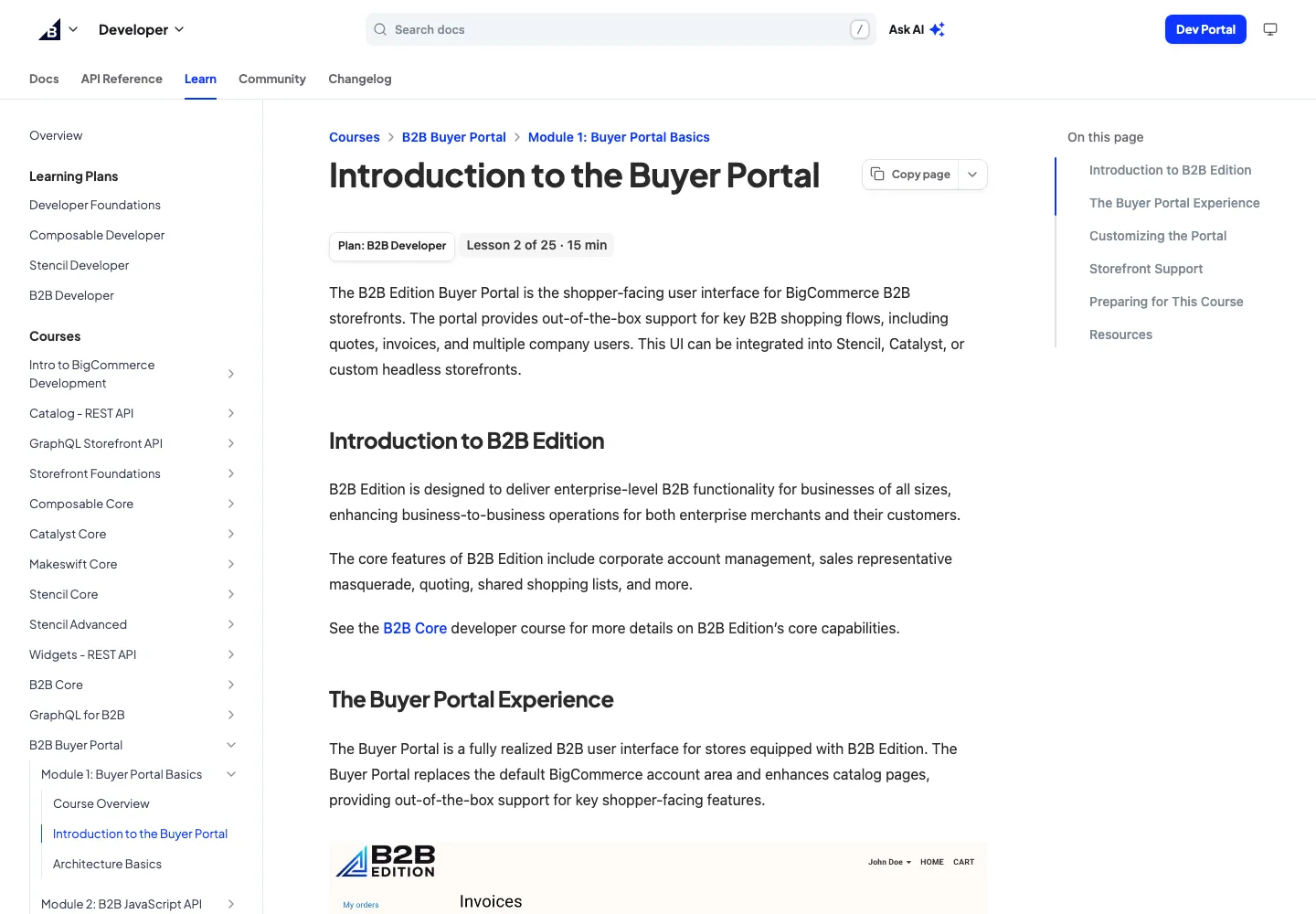
A wholesale price list only changes totals. BigCommerce's B2B Edition Buyer Portal changes how a purchase gets quoted and invoiced, and how company users participate in the process. Documented buyer functions include quotes, invoices, multiple company users, corporate accounts, sales rep masquerade, and shared shopping lists B2B Edition Buyer Portal overview. For a corporate purchasing team, these are operating controls rather than discount mechanics: buyer identities and order documents live inside a company account, giving support and sales staff a defined context for helping customers.
One typical requirement illustrates the fit. Suppose your buyers must submit a quote request, a purchasing manager must approve it, and finance must receive the invoice. That sequence is an example of what you might configure, not a documented default workflow. The documentation describes the building blocks, so the test is whether your configured permission model reproduces that path. Ask for a demonstration of that path with your roles before rollout.
Multiple company users under one corporate account let a purchasing team share billing and shipping context. Sales rep masquerade lets your staff view the store as the buyer sees it, which helps answer catalog or line-item questions. Shared shopping lists support repeat orders and reduce re-keying for common buys.
These features require a store equipped with B2B Edition, and the edition is not guaranteed on every base plan. Confirm it is included in your chosen plan and at what price before planning around it; treat additional commercial terms as part of the contract scope. The front-end integration is documented for Stencil themes, Catalyst storefronts, and custom headless builds B2B Edition Buyer Portal overview, so the portal can work with the architecture you already run. That does not remove the need to scope implementation effort, but it means the capability is available, not a custom invention.
For a merchant evaluating wholesale business, the practical question is not whether B2B exists but whether the quote-approval-invoice sequence you need matches what you can configure. I would build that test into the evaluation before signing, because the documented feature list alone will not tell you whether your approval chain works.
Sales growth and payment choice affect platform fit
BigCommerce separates plan eligibility from monthly fees. Core and Growth are capped at $30k and $100k TTM GMV; Scale instead uses a $33,333 monthly InclusiveGMV threshold with 0.9% overage above it plan-pricing-updates-2026. InclusiveGMV is gross order value reduced by 10%, so it is an accounting base, not profit. TTM is a rolling 12-month total: replacing an old month can move you across a boundary even when current monthly volume looks stable. Forecast the whole window, not just the quarter ahead.
Community accounts show why payment choice affects the buying decision differently. One August 2026 merchant reported frustration reconciling fees on manual and check-based orders open payment provider fee thread. Another seller already using Braintree said they noticed no difference, and a reply identifying as Commerce staff said BigCommerce Payments is optional and other embedded providers exist BigCommerce Payments thread. Those are self-reported results, not a formal test, but they align with the official rule that your processor mix determines whether the platform fee is visible.
Official terms explain both reactions. The provider fee applies to eligible Open Provider GMV, computed from InclusiveGMV after subtracting GMV settled through embedded providers. Classification follows the processor actually used on each order, and manual or offline purchase orders count. A merchant taking phone or check orders can therefore build up fee exposure without a card transaction on the storefront. Embedded providers avoid the platform fee, though processor fees still apply. I would read the current schedule before assuming a payment setup is automatically cheaper plan-pricing-updates-2026.
The Scale overage is monthly, so seasonal sellers should model peak months, not average revenue. A strong holiday month can add meaningful overage even if the year looks flat. BigCommerce also upgrades Scale to Performance automatically at $2M TTM GMV; since contracted Performance is exempt from the open-provider fee, price that path against contract terms before you hit the boundary. Existing annual contracts do not freeze all future costs, so confirm migration timing and mid-term plan changes. Track plan caps and processor mix separately; the BigCommerce pricing analysis works those examples with current rates.
Implementation and support need a defined handoff
BigCommerce is hosted, so the platform core removes typical infrastructure duties. The remaining work is data and configuration: product fields, variants, inventory, currencies, and permissions need structure before storefront settings can do their job Multi-Storefront overview. A custom front end adds its own hosting and infrastructure decisions. The managed core still provides checkout and data services, but the headless application on top belongs to you or your contractor, so the handoff covers both sides.
The pilot is the honest test of that handoff. Load sample products with variants into a staging or trial store. If multi-storefront is in scope, add a second storefront with a different default currency; if B2B Edition is in scope, create a corporate buyer and run a quote request through the portal B2B Edition Buyer Portal overview. The result shows where native settings end and custom integration begins, without assuming every capability applies. I would make the pilot the decision input, not another merchant's self-reported experience.
Support differs by plan: Core gets chat and email; Growth, Scale, and Performance add phone BigCommerce pricing. During implementation, confirm who performs catalog mapping, currency setup, and permission configuration, and what documentation you receive when the build transfers.
Ownership is a contract question. Ask who owns the configured storefront data, product schemas, and any custom headless application, and what export formats are available if you leave. Record the confirmed answers in the implementation plan before committing to a multi-year term.
Compare alternatives against the same difficult workflow
Run every candidate through the same three requirements used here: separate storefronts from one backend, quote-to-approval-to-invoice under company accounts, and forecastable cost when GMV or processors change. Drop any requirement outside the merchant's actual workflow. A multibrand retailer tests storefronts; a wholesale merchant tests approvals. Score only what is required.
Collect the same evidence for each candidate from current documentation, a written quote, and a staged demo, noting features dependent on apps, add-ons, or custom builds. Shopify is a hosted plan with plan gates and payment economics; WooCommerce is a self-managed core with chosen extensions. Treat them as different architectures, not assumed feature parity.
| Requirement | BigCommerce evidence | Comparison test |
|---|---|---|
| Separate storefronts | Multi-Storefront manages separate storefronts from one backend with per-storefront currency, content, themes, and product config. | Does it run separate storefronts with independent currency/config from one backend, with add-on costs stated? |
| Quote, approval, invoice | B2B Edition Buyer Portal documents quotes, invoices, multiple company users; approval chain not shown. | Can it run your exact approval chain before invoice, with B2B included or paid? |
| Predictable cost | Plan pricing updates set Open Provider fees and Scale overage; Performance is contracted. | Does it publish equivalent fee schedule at your volume, yearly sum and peak month separate? |
Apply the same table to each candidate from staged demos and current quotes. Sum all modeled months across twelve months, then note the peak month separately for cash exposure. Include implementation and maintenance hours. An annual subscription fixes the tier rate, not fee outcomes, so confirm threshold-triggered upgrades during the term. A cheaper base plan loses if workarounds exceed the saving.
What would make the final decision
BigCommerce is a strong candidate when the platform's managed model reduces your operational risk and its published pricing fits your revenue scale. The main caution is not customization itself; a bounded integration can be justified if it solves a named workflow and pays for itself. What should end the evaluation is an unbounded build or vague scope.
The sharper commercial check is the variable fee structure. BigCommerce now applies Open Provider fees to eligible transactions and Scale overage on monthly InclusiveGMV above 33,333 USD plan-pricing-updates-2026. If your order mix includes manual purchases or your processor relationships change, these charges can undo the advantage of a lower base plan. Model those costs against your actual gateway mix before committing rather than relying on advertised base rates.
A positive impression of the product is therefore not enough. The final decision should rest on whether total cost, including provider fees and any custom integration, stays bounded and delivers measurable return. If you cannot name the missing workflow and price its implementation, or if the cost structure diverges from your volume, reject on commercial grounds even when the software seems capable.
Related reading
- BigCommerce pricing analysis: model Scale overage and provider fees against your actual gateway mix.
- Shopify review: compare hosted plan tiers and B2B terms if a single backend with separate storefronts is less central.
- WooCommerce review: evaluate a self-managed core if custom catalog control outweighs managed hosting.