Pricing
BigCommerce Pricing After the 2026 Plan and Fee Changes
BigCommerce 2026 pricing breakdown: TTM GMV plan eligibility, Scale overage fees, and Open Provider fees on self-serve plans, with cost model examples.

BigCommerce's 2026 pricing is three separate rules: trailing 12-month GMV decides plan eligibility, Scale adds a monthly overage once inclusive GMV exceeds $33,333, and self-serve plans pay an Open Provider fee on eligible orders outside embedded providers. I'd start with eligibility. Core at $29/month billed annually works up to $30,000 TTM; Growth at $79/month billed annually fits $30,000-$100,000 TTM, or when you need features Core lacks. Above $100,000 TTM, Scale applies; do not buy Growth past that cap.
The bigger concern is the Open Provider fee on manual/offline orders; seasonal peaks matter too because Scale's overage is calculated monthly, not averaged. Merchants with many orders outside embedded processors should model both fees, even when no card processor is involved. Community reports of billing frustration after the change reinforce this caution; they are self-reported, not verified bills, but they match the official fee structure.
That judgment comes from the official plan pricing updates and pricing page checked 20 October 2026, plus community evidence, not hands-on testing.
Current plans and base commitments
BigCommerce renamed its self-serve tiers on 1 June 2026: Standard became Core, Plus became Growth, Pro became Scale, and Enterprise became Performance (plan and fee update). Prices exclude tax. The first three tiers have published monthly and annual rates; Performance is quoted individually (pricing page).
| Tier | Former name | Monthly billed (USD) | Annual equivalent per month (USD) | Upfront annual invoice (USD) |
|---|---|---|---|---|
| Core | Standard | 39 | 29 | 348 |
| Growth | Plus | 105 | 79 | 948 |
| Scale | Pro | 399 | 299 | 3,588 |
Paying annually saves money on the term you pay for. On Growth, annual billing costs $948 upfront instead of $1,260 spread over twelve months, a $312 saving. That rate applies to the term you prepay; eligibility thresholds and variable fees remain separate from the subscription rate. Annual billing also commits cash ahead of revenue, so a younger store with uneven sales may prefer the monthly rate to protect cash flow.
Performance is the exception to published pricing. The listed $1,499 per month billed annually is a starting quote, not a firm public rate, and contract terms vary by deal. Before planning around it, confirm overage treatment, term length, and what is included in the contract.
Three measures drive three different charges
One BigCommerce invoice can contain charges computed from three different versions of sales volume. They share one starting definition, but they serve different mechanisms. Plan eligibility is not an additive fee; it determines which plan's base price and variable rates apply.
Inclusive GMV is the common base: BigCommerce defines it as gross order value reduced by 10% (plan and fee update). Consider a store with a gross order value of $80,000 in a month; the inclusive figure is $72,000. That reduction is a calculation input, not profit; it does not mean the store keeps 10% more revenue, and it does not change what the processor charges on the original transaction amount. If your dashboard already shows Inclusive GMV, use that number directly; do not subtract 10% again.
Three rules read three slices of that base:
- Trailing 12-month inclusive GMV establishes plan eligibility. Crossing a threshold can move a store to a higher plan between renewals, but eligibility never appears as its own charge.
- Monthly inclusive GMV drives Scale's overage when it exceeds the $33,333 allowance. The rule uses that month's total, not a rolling average or annual balance.
- Open Provider GMV is the residual after embedded-attributed GMV is subtracted from monthly inclusive GMV, with a zero floor. Manual and offline purchase orders count when no embedded provider is attributed. The official formula is max(InclusiveGMV - embedded-attributed GMV, 0); the fee is a percentage of that residual, not a fixed amount per order.
| Measure | Basis | What it drives |
|---|---|---|
| TTM Inclusive GMV | Rolling sum of last 12 calendar months | Plan eligibility and automatic upgrades |
| Monthly Inclusive GMV | Current calendar month inclusive GMV | Scale overage above $33,333 |
| Open Provider GMV | max(Monthly Inclusive GMV - GMV attributed to Embedded Payment Providers, 0) | Tiered platform fee |
These numbers share a starting point but move independently: a store with $72,000 in monthly inclusive GMV might have only $20,000 subject to the open provider fee if the rest runs through embedded providers, while another store with identical GMV owes more because its processor mix differs. TTM position moves on a twelve-month window, not any single month, while overage and open fees reset monthly. None cancels another; each follows its own rule.
When modeling, start from the same adjusted figure the rule uses. If you already have an inclusive GMV account number, feed it in unchanged. Only if you begin with a raw gross order value should you apply the 10% reduction first. Comparing gross sales against the allowance or fee base overstates where you stand.
Trailing year sales determine plan eligibility
Plan eligibility is based on trailing 12-month Inclusive GMV, not the current month’s revenue. Core covers stores up to $30,000 TTM, Growth up to $100,000, and Scale moves automatically to Performance once TTM reaches $2 million (plan and fee update). Because the window is a rolling sum, each new month enters while the oldest drops out; the total changes by the difference between those two months.
A Core store with $28,000 TTM shows why. If the oldest month of $2,000 rolls off and the newest adds $5,000, the new TTM is $31,000. That crosses the Core ceiling even though the latest month alone is far below it. The store qualifies for Growth because the rest of the window was near the limit, not because it had one strong month. Monthly revenue alone will not show this.
Upgrades are not deferred to renewal. BigCommerce can move a store between plans when TTM crosses a threshold, and ongoing GMV upgrades can occur during an annual term with notice (plan and fee update). An annual prepayment does not freeze your tier for the full year. This is also separate from Scale’s monthly overage, which is computed from the current month’s inclusive GMV and resets monthly.
Downgrades do not work the same way. A sales dip does not immediately qualify you for a lower plan: high months remain in the twelve-month window until they age out, and eligibility depends on the rolling figure plus the account change process. That window can even move upward while you wait. If a Growth store at $95,000 TTM sees a $5,000 month roll off and an $11,000 month arrive, the new TTM is $101,000, which moves above the Growth ceiling. The trigger is still the trailing total, not that single month. When the window actually falls below a cap, confirm the downgrade path with BigCommerce before assuming it happens automatically or after a fixed delay.
Check TTM monthly. If you are within roughly one month of expected revenue from a threshold, model the next quarter so you can anticipate the higher tier’s base and variable fees before the invoice arrives. For how the platform behaves under these pricing rules, see the companion BigCommerce review, which is based on documentation rather than merchant testing.
Scale overage applies only above the monthly allowance
Scale's variable charge is a monthly calculation for each calendar month, not an annualized average. The formula in the plan and fee update is max(inclusive GMV − $33,333, 0) × 0.009. Any month at or below the allowance produces $0. There is no carryover: a quiet month does not create credit against a later peak.
| Monthly inclusive GMV (USD) | Overage: 0.9% above $33,333 | Scale total with $299/mo annual-equivalent base |
|---|---|---|
| $20,000 | $0 | $299 |
| $40,000 | $60 | $359 |
| $60,000 | $240 | $539 |
| $100,000 | $600 | $899 |
The table assumes the $299/month annual-equivalent base; monthly-billed stores pay $399 instead. At $60,000 inclusive GMV, the excess is $26,667 and the overage is $240, not $540 on the full amount. Every additional $1,000 above the allowance adds $9, and the rate stays flat as volume grows.
For an annual budget, model each of the 12 calendar months separately and sum the 12 overage results. Peak months reveal cash exposure, but the full-year total is the sum of the monthly maximum-function results, not a projection from one or two high months. A store that does $20,000 most months but $100,000 in November pays $600 overage that month, on top of the $299 base, and $0 in quiet months. The fee is calculated monthly in arrears, so a spike over the allowance has an immediate cost of $9 per $1,000 above it.
When reconciling, use the same formula with inclusive GMV (gross order value less 10%) rather than gross order value; below the allowance, the maximum function returns zero.
Open Payment Provider fees follow the actual order
The Open Provider fee is the part of the 2026 pricing most tied to how an order is actually processed. Self-serve plans pay 2.0% of eligible Open Provider GMV on Core, 1.0% on Growth, and 0.6% on Scale; contracted Performance is exempt from this fee (plan and fee update). It is billed monthly in arrears and remains separate from Scale's overage. The official fee table below shows the rates as published.
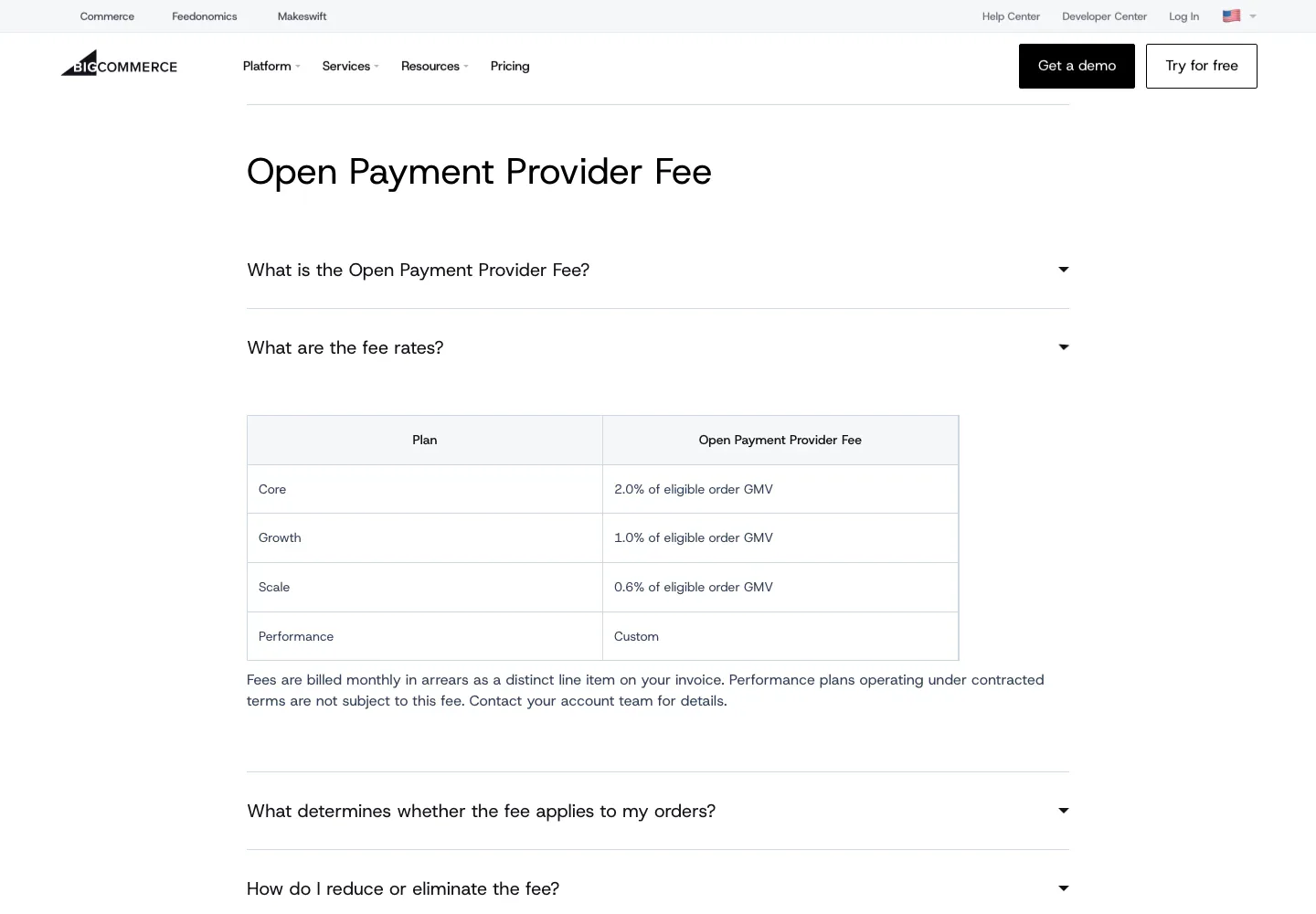
The fee base is Inclusive GMV after the built-in 10% reduction, minus GMV attributed to embedded providers, with a zero floor. Classification follows the provider that processes each order, not the payment method shown at checkout, so manual and offline purchase orders enter the calculation when no embedded provider is attributed. Hand-invoiced B2B sales are therefore not automatically exempt.
Those mechanics explain why community reaction splits. One merchant posted about frustration reconciling fees on manual/check orders (thread); the thread's dollar amounts are unverified, but the underlying issue matches the official inclusion of offline orders.
Another merchant who already used Braintree said they noticed no difference (thread). That is plausible for an embedded provider, but it is not proof every account is unaffected. Confirm which gateways count as embedded on your account before assuming the fee will not apply.
Choosing an embedded provider removes this platform fee, but it does not remove processor fees. A zero platform fee can still lose to a cheaper non-embedded gateway once processor pricing is compared. For a Growth store, $10,000 of eligible Open Provider GMV creates a $100 fee, so the line item deserves a fixed place in a monthly cost model, not an occasional surprise. A change to an embedded provider only wins when it covers your payment workflows and the all-in cost still works.
If you handle many checks or invoiced orders, I would treat that as a recurring cost and evaluate whether an embedded option actually covers those workflows. The Performance exemption only covers the Open Provider fee; it does not promise the absence of other contracted charges, so read the contract's overage terms before assuming a custom deal has no variable fees.
A store forecast with both variable fees
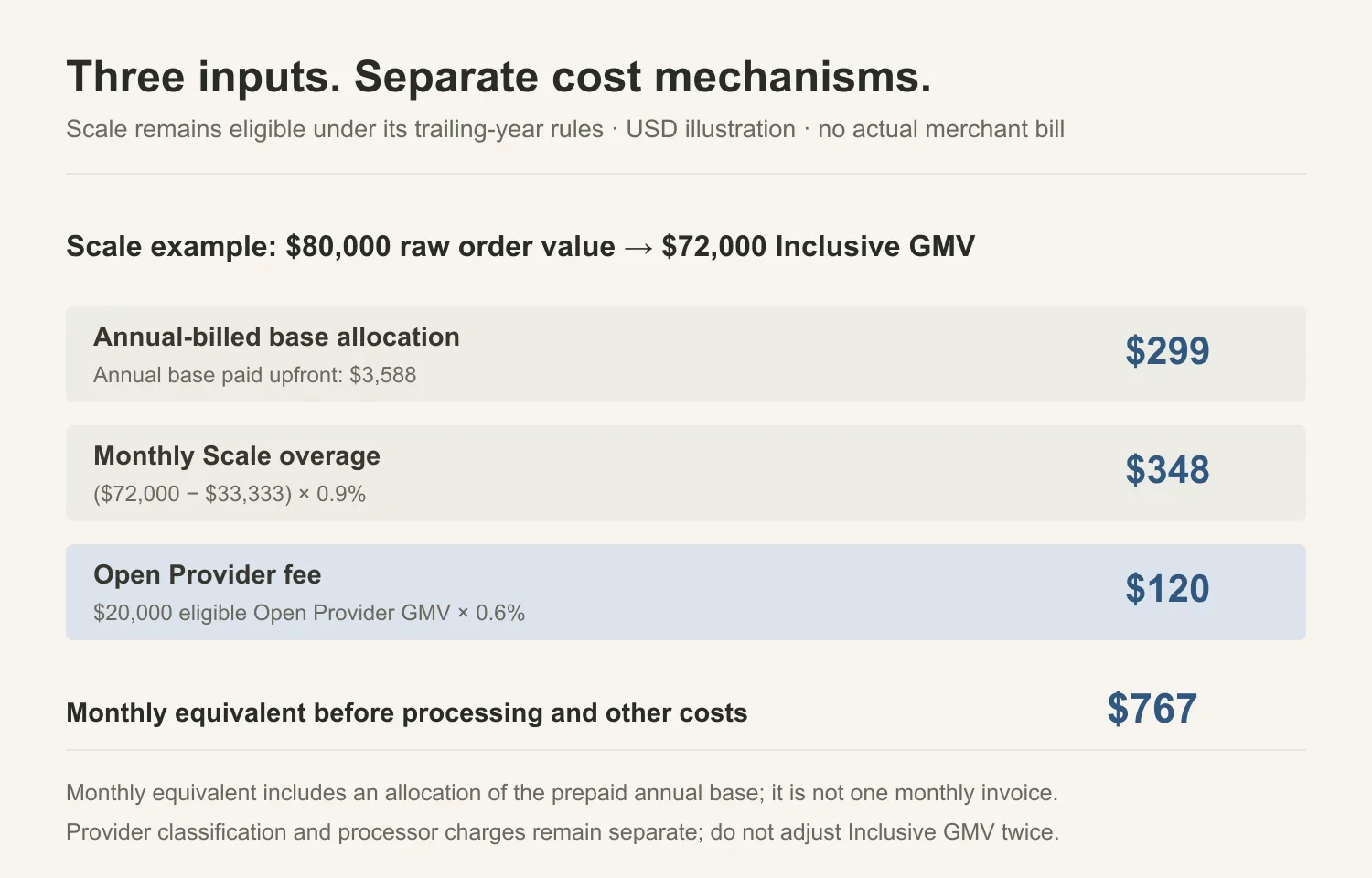
This worked example models a hypothetical Scale month, assuming the store remains on Scale. It is not a reported invoice. A month with $80,000 in gross orders becomes $72,000 in Inclusive GMV, the adjusted figure used below. Of that Inclusive GMV, $52,000 is attributed to embedded providers, leaving $20,000 as eligible Open Provider GMV; those are input assumptions, not a per-order allocation of the raw $80,000. The month produces two independent charges: Scale overage of $348 and an open provider fee of $120. Adding the $299 monthly allocation of the $3,588 annual base gives $767 before processor costs.
| Forecast scenario | Monthly Inclusive GMV (USD) | Eligible Open Provider GMV (USD) | Scale platform cost (USD) |
|---|---|---|---|
| Busy month, mixed processing | 72,000 | 20,000 | 767 |
| Busy month, all embedded | 72,000 | 0 | 647 |
| Quiet month, mixed processing | 20,000 | 5,000 | 329 |
Assumptions: $299 per month allocated from the $3,588 annual Scale base; Scale overage at 0.9% on monthly Inclusive GMV above $33,333; open provider fee at 0.6% on eligible Open Provider GMV; no taxes or processor fees. Dollar amounts are rounded to the nearest dollar. These are arithmetic models under the published plan and fee update rules, not invoice excerpts.
The all-embedded variant avoids the $120 open provider fee that month, before any change in processor costs. That is not a guaranteed net saving of $120 every month: the gateway mix and eligible open volume must stay the same, and the embedded processors' own pricing may differ from what the open provider charges. Treat the $120 as one input to a broader processor comparison, not a fixed monthly gain.
The quiet month shows a $0 overage because $20,000 is below the allowance, and a $30 open fee on the $5,000 open slice. This forecast assumes the account remains on Scale. Scale is not automatically lost or downgraded when trailing 12-month Inclusive GMV falls below the Growth cap; merchants can voluntarily retain it. If the account actually changes tier, reprice the month under that tier's terms.
Annual billing and contract changes affect cash flow
Annual prepayment secures the discounted rate for the term you prepay; it does not fix future plan eligibility or variable fees. On Scale, annual billing is $3,588 up front versus $399 monthly, with the $299 monthly equivalent available only with prepayment. If cash flow is tight, monthly billing buys flexibility at a higher price.
The 2026 migration date does not defer every fee. Existing annual subscriptions move to the renamed Core, Growth, Scale, and Performance plans at the end of their current term, not at the June 2026 plan-name change. GMV-triggered upgrades can occur during an annual term with notice (official pricing-update page). Prepayment covers the selected tier, not protection from a threshold upgrade.
Variable fees remain monthly. Open Provider fees are billed in arrears, and Scale overage is recalculated each calendar month against the $33,333 inclusive-GMV baseline. A prepaid Scale store still receives monthly invoices for those amounts.
In July 2026, Reddit user GoldTrek said they were happy with BigCommerce’s platform and service but left after billing changes (thread). That is one merchant’s self-reported experience, not proof every store received the same increase; model your own volume mix before prepaying.
For a comparable hosted platform, our Shopify pricing breakdown models subscription, app, and processing fees. Compare total monthly cost across platforms rather than judging by headline plan prices.
Add implementation apps and the selected services
The plan prices above cover the hosted core, not everything a store pays for. Multi-storefront lets you manage separate storefronts from one backend, each with its own themes, widgets, scripts, pages, default currency, emails, subscriber management, and product filtering (multi-storefront page). Its rate is not published in the materials reviewed here, so treat it as a scoped commercial requirement and get a proposal before budgeting.
B2B Edition Buyer Portal adds quotes, invoices, multiple company users, and shared shopping lists, and it works with Stencil, Catalyst, or custom headless builds. It requires a store equipped with B2B Edition, which is not a free entitlement on every base plan (B2B buyer portal guide). For B2B sellers, this is a meaningful reason to consider BigCommerce, but its price and setup should be confirmed before launch.
Support tiers matter separately. Growth, Scale, and Performance include phone support; Core has chat and email, with a proposed phone add-on that BigCommerce has not yet priced (pricing page). If you need voice support during peak periods, factor that gap into the choice between Core and Growth.
When implementation is done, keep four cost streams separate: one-time build work, the platform subscription, app subscriptions, and processor fees. Build covers migration, theme work, and integrations. Apps bill on their own schedules, sometimes annually, which can land in a month that only budgeted monthly app spend. Processor statements come from your gateway and should not be netted against BigCommerce fees.
I would not decide on either platform or processor by reputation; run a side-by-side that accounts for both platform and processor differences. Build your actual order mix, processor pricing, and expected B2B or multi-storefront requirements into that total. A provider change only wins when it covers the workflows you need and the combined cost is lower; otherwise staying put and fixing the reconciliation may be the better buy.
Related reading
- BigCommerce review: how the platform stacks against its documented pricing and feature commitments
- Shopify pricing breakdown: a contrasting subscription and processing schedule
- WooCommerce pricing overview: hosting and plugin costs framed on an annual budget