Best tools
Best Shopify Subscription Apps: What I Would Choose and Pay
Shopify Subscriptions: free for refills. Appstle for bundles if revenue fits tiers. Seal for flat-cost catalogs. Recharge only if retention gains exceed fee.

When choosing, I focused on failed payments and subscriber changes, because that is where a subscription app's settings matter most. Using official docs and pricing pages checked 21 October 2026, I compared how each app handles them.
For a standard replenishment product, I would choose Shopify Subscriptions: it bills on weekly, monthly, or yearly schedules and is free.
If you sell boxes or bundles, Appstle is my choice when your revenue fits its published tiers: Business costs $30/month up to $15,000, and Business Premium costs $100/month up to $100,000. Seal is the budget pick when your limit is subscriptions, not unique people: free for 50 subscriptions, then $5.95–$24.95/month.
Recharge's variable fee pays off only if you need advanced retention or integration features; otherwise the per-transaction cost is hard to justify.
The four-app shortlist and its deal breakers
The table below isolates each app's main trade-off. Match the app model to the offer before comparing bells and whistles.
| App | Best fit | Deal breaker | Charging basis |
|---|---|---|---|
| Shopify Subscriptions | Fixed weekly/monthly/yearly replenishment | Bundles are unsupported; see native considerations. | Free app; normal store/payment costs remain. |
| Appstle | Boxes, bundling, and cancellation control | Revenue-band caps put build-a-box on the paid Business tier. | Monthly subscription-revenue bands; paid tiers charge no app transaction fee. |
| Seal | Flat-cost subscription basics | Subscription-count caps count subscriptions, not unique customers; paused and cancelled count unknown. | Flat monthly tiers by subscription count. |
| Recharge | Advanced retention and integrations | Variable per-transaction fee makes frequent low-value renewals expensive. | First subscriber band flat; then percentage plus per-transaction fee. |
One customer with two recurring agreements consumes two subscriptions, so subscription count and revenue tiers are priced differently as order value increases.
The consequence is direct. Single-SKU refills on a fixed cadence should stay on Shopify Subscriptions. Boxes and bundles point to Appstle's Business tier, with its revenue-band billing. Simple catalogs fit Seal, but size its cap against the subscription agreement count your plan implies. Choose Recharge only when you have a specific retention or integration need; otherwise, native or flat-fee options avoid its per-transaction cost.
What 500 monthly renewals actually cost
This cost model assumes 500 active subscriptions from 500 unique subscribers, each completing one successful $50 renewal per month. That gives $25,000 in monthly revenue and 500 card transactions. The table shows app subscription fees at that volume, not total Shopify costs; platform and payment costs remain separate, and the rows serve different feature needs rather than being interchangeable.
| App | Monthly fee at this volume | Charging basis |
|---|---|---|
| Shopify Subscriptions | $0 | Free app; normal store and payment costs remain |
| Seal Legend | $24.95 | Flat fee for up to 500 subscriptions; unlimited revenue |
| Appstle Business Premium | $100 | Revenue tier |
| Recharge Starter | $566.50 | $99 + 1.49% of revenue + $0.19 per transaction |
| Recharge Plus | $929 | $499 + 1.34% of revenue + $0.19 per transaction |
Seal charges a flat fee regardless of revenue, while Recharge's variable pricing ties software cost to both order value and transaction count. Appstle's revenue-tier billing makes the $100 Business Premium tier the right row for $25,000 in monthly subscription revenue. For Shopify's own platform costs, see our Shopify pricing breakdown.
The Recharge Starter-to-Seal Legend gap is $541.55 per month. At a 40% contribution margin, $1,353.88 of additional retained gross revenue in the same billing period produces $541.55 of contribution and covers that gap. That is a break-even threshold under a recovery scenario, not a measured result. If Recharge's retention tools cannot plausibly generate that much additional same-month gross revenue, its higher fee is hard to justify; above the threshold, the incremental contribution is net gain.
Where the free and flat-fee apps stop
The free or low-cost entry point does not reveal the governing limit. Monthly subscription revenue, subscription count, and gateway support each define when an app's advertised price stops applying.
Shopify Subscriptions: free, with a specific fit
Shopify Subscriptions bills weekly, monthly, or yearly and lets customers cancel, skip, or pause without contacting the store. The app itself is free; store and payment costs remain. The decisive boundary is product fit. A multi-SKU bundle offer fails the documented compatibility limit, because the native app does not support bundles. Payment gateways are also restricted to Shopify Payments, PayPal Express, Authorize.net, Adyen (with approval), and Stripe (select merchants only), subject to regional and method conditions.
If your store uses a gateway outside that set, or sells bundles, native subscriptions are not the right default. Failed-payment and insufficient-inventory retries are configurable in app settings.
Appstle: revenue caps decide the next tier
Appstle prices by monthly subscription revenue. The Business tier covers up to $15,000; once revenue exceeds that number, the same store needs Business Premium even if its subscriber count has not changed. Build-a-box, bundling, action logs, and cancellation control are Business features, not lower-tier options, so box sellers should size expected revenue against the cap before launch. The free tier caps at $500, paid tiers scale upward, and add-ons are quoted separately. Paid tiers advertise 0% app transaction fees, but those fees are separate from payment processing.
Seal: subscription-count caps
Seal prices by subscription count, not revenue or unique customer accounts. The listed free tier covers 50 subscriptions; paid tiers step up to 500 subscriptions, and larger plans exist but are not priced in the listing. The documentation does not verify whether paused or cancelled subscriptions count toward the cap, so ask the vendor which paused or cancelled contracts count before selecting a tier. At the Supersale tier, customers get a passwordless portal and renewal reminders; RisingStar adds price updates and a custom cancellation flow.
Revenue is unlimited at every tier, but crossing the current subscription-count cap requires a vendor quote for the next plan, making the number of subscriptions the real ceiling. A high-ticket store can make the flat fee worth more, provided the subscription count stays within the tier it is paying for.
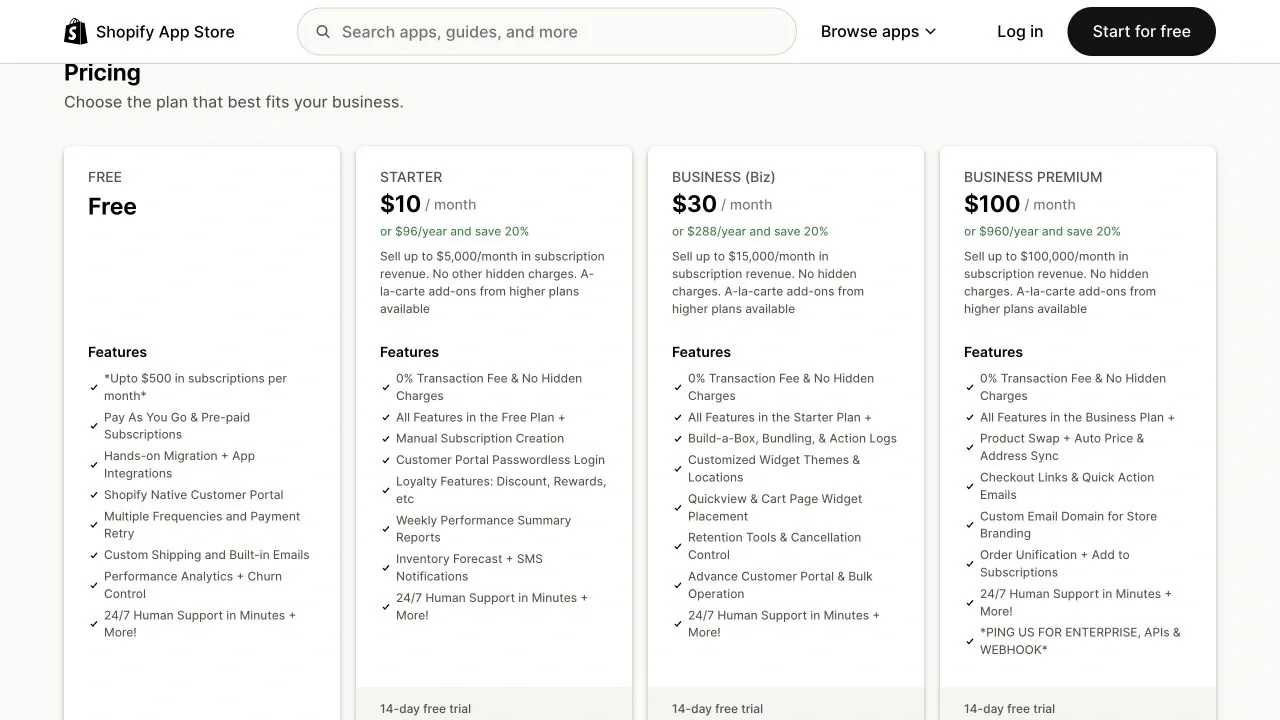
Image source: Appstle on the Shopify App Store
The case Recharge has to make
Recharge's paid tiers are worth their variable fees only when a specific requirement maps to a documented feature. The app listing puts the customer portal, upsell, cancellation prevention, failed payment recovery, and analytics on Starter; Plus adds customizable bundles, tiered discounts, hands-on implementation, loyalty tools, JavaScript SDK, and Storefront API. Customer retention is valuable because it preserves customer lifetime value, but that lifetime value does not automatically offset Recharge's monthly fee. To assess the fee, compare the monthly premium with the incremental contribution you expect in the same billing period.
The feature-tier boundary matters more than the price lines: if a store sells simple replenishments, Starter's retry and portal features may justify the fee. If the offer requires custom bundling or a fully embedded subscription flow, Plus is the tier to assess.
One merchant review illustrates what Recharge does and does not prove. On the Recharge listing, Alma Coffee's review, edited 22 October 2026, reported a positive return to Recharge and helpful migration assistance, but said the migration required more work than earlier moves. That is a selected merchant report on migration effort, not evidence that a specific integration was implemented, and it contains no measurement of retention results. Use it to budget for migration help, not to project uplift.
A competitor exchange shows why feature-boundary questions need to be asked before committing. HTLT Supplements Europe reported on 28 July 2026 that dashboard access was blocked after the free revenue threshold. Appstle replied on 29 July 2026 that dashboard access is restricted above the threshold, while existing renewals, customer portal, and new signups continue. The threshold restriction is confirmed, but the merchant's complaint was specifically about dashboard access, not lost renewals.
Before paying for any tier, request the exact feature list for your expected subscriber and revenue volume, and ask which dashboard actions remain blocked above the quoted cap.
Ask for these renewal and customer-change demonstrations
Lock in your own policy before requesting demos: write down the retry count, the action after retries are exhausted, how swaps are priced on the next cycle, and your skip cutoff. Pass/fail follows those written decisions, so a scenario fails only when observable behavior contradicts them.
| Scenario | What to inspect | Reject if |
|---|---|---|
| Successful first renewal | On-time charge at agreed amount; confirmation sent; line items correct | Double charge, early charge, or no transaction record |
| Decline, card update, exhaustion | Retry count and interval match your setting; updated card resumes cycle; exhaustion triggers chosen action; notifications match event | Updated card cannot resume billing, or exhaustion skips your chosen action |
| Bundle component out of stock | Subscriber sees your promised substitution or delay; no surprise partial charge; inventory status accurate | Promised substitution or delay never appears, or the order stalls with no action |
| Next-cycle swap pricing | Swap amount, proration, effective date match policy; no retroactive changes | Amount changes without notice, or terms you said stay fixed are rewritten |
| Customer skip near cutoff | Skip registers inside your stated window; valid skip blocks any charge; portal shows new charge date | Valid pre-cutoff skip still charges, or portal shows no new date |
Omit the bundle row if you sell fixed replenishment only. A support-assisted pause is acceptable if that is your policy, but count every pause as a ticket and add that labor cost to the comparison. Test the portal from a phone, not just desktop: the customer should see the next charge date, update payment details, pause when your policy allows it, and read the latest confirmation. Show the charge date in the portal and send separate fulfillment/tracking updates for resulting orders; shipment updates address WISMO enquiries.
A decline email should name the amount, product, and next step, not just say billing failed.
Score each app during the demo, not after. The editable renewal budget and fee break-even sheet covers the 500-renewal math; the table above is the live scoring step.
Move contracts only after the next-charge path is clear
A contract migration is complete when the new app holds the customer record and contract terms. Billing validation completes only after record counts reconcile against the source store and the first billing cohort is charged, recorded, and reconciled. Until both checks pass, treat the cutover as unfinished.
The native import/export documentation covers moving contracts from third-party subscription apps into Shopify Subscriptions and exporting to another Shopify store running the native app. It does not guarantee any payment vault or gateway token transfer. CSV portability is limited to contract metadata; charging authority depends on the receiving payment route. The uninstall warning says uninstalling makes app features unavailable and deletes plans, contracts, and associated discounts, so confirm the receiving vendor's charge route before uninstalling.
Appstle's Braintree migration guide shows the shape of a gateway-specific move: connect legacy Braintree, export customer and subscription data, have the vendor validate, and import subscriptions paused to avoid double charging. That document is dated 23 August 2024 and is not a promise for every gateway. Its post-migration checklist targets products, shipping, prices, and quantities, associates plans with migrated contracts, and keeps imports paused until activation is coordinated. Compare record counts, addresses, dates, and discounts against the source store as part of that check.
Assign one person to stop old billing and start new billing. Set a cutoff for old renewals and configure the new system not to charge before that cutoff passes. Tell subscribers the date billing changes, when the next charge will occur, and whether they need to update card details. A silent migration reads as a billing error.
Do not treat the old app as a rollback path after a token move. Keep the original data and configuration until the receiving vendor confirms the charge route and the first billing cohort has reconciled; then uninstall. When comparing vendors, ask each for a migration quote with timelines and a paused-import step. If a vendor cannot confirm the charge route and the paused-import sequence in writing, it is not ready to take your contracts.