Implementation
Commercial invoice template for a US customs entry
Use this commercial invoice template for US imports. Download Word and PDF files, review a completed example, and check required shipment fields.
Download the US import invoice

Use this commercial invoice template to organize a US import’s seller, buyer, merchandise, currency, origin, classification references, and itemized charges. It includes an editable Word form, matching PDF, and completed fictional shipment. Keep it with the transaction records and your shipping documents; a parcel’s packing slip cannot supply the same information.
A supplier invoice can add correctly and still leave the importer unable to explain the goods or their value.
Missing charges and vague product names create work at the point where the shipment needs a clear record.
This US import form helps you prepare the data a broker or carrier may request. The worked example shows how a seller invoice can total $1,089 while customs valuation still requires a separate review.
Download the Word commercial invoice template, then compare it with the completed example PDF before entering your own shipment.
Download the invoice and completed example
The blank Word file contains two pages: the main invoice and an attachment for additional disclosures. Its printable PDF version preserves those pages. Use both when the attachment holds information that the main invoice does not show.
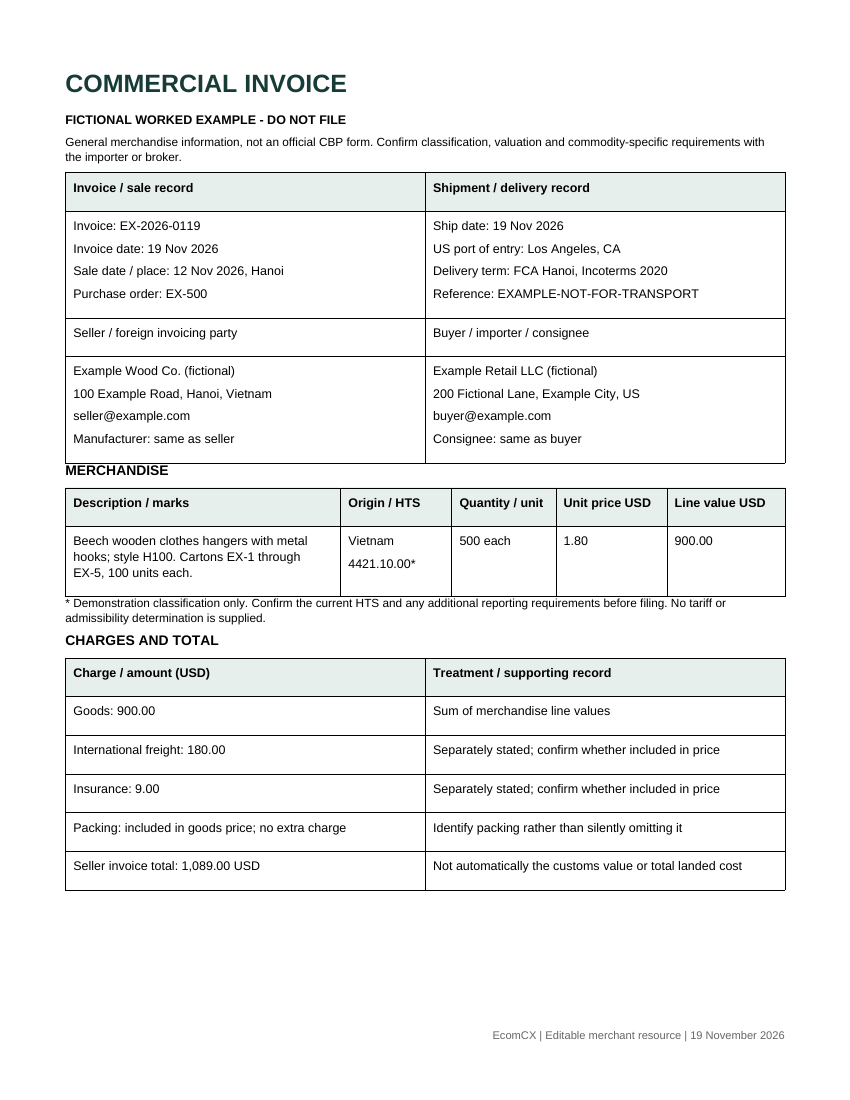
The completed example uses fictional businesses, addresses, quantities, and charges. It describes 500 wooden clothes hangers sold for $1.80 each. Goods total $900; separately stated freight and insurance bring the example seller invoice to $1,089. That seller total is not a declaration of customs value.
| File | Use | Before sending |
|---|---|---|
| Editable Word template | Enter shipment-specific information | Remove prompts and check the attachment reference |
| Blank PDF | Inspect or print the form | Confirm both pages remain readable |
| Completed example PDF | Understand field treatment | Do not reuse fictional parties or classification |
The template is an original preparation resource, not an official US Customs and Border Protection (CBP) form. A carrier, broker, or commodity may need additional fields or its own submission format. If your carrier requests its own paperwork, use its instructions and transfer the verified details. Compare the FedEx commercial invoice or check UPS international forms before sending the file.
The fulfillment guide helps allocate shipping responsibilities. For this invoice, identify one person who owns the final version and who can obtain missing seller information. A forwarding email chain is a poor version-control system when quantities or charges change.
Separate required data from useful shipping fields
The main US general-content rule is 19 CFR 141.86. It covers parties and transaction details, merchandise descriptions, quantities, prices and currency, named charges, origin, and relevant assists. The template’s attachment makes those additional disclosures visible rather than assuming they are absent.
19 CFR 142.6 addresses information furnished with entry before release. It includes an adequate description, quantities, values or approximate values, the appropriate eight-digit Harmonized Tariff Schedule (HTS) subheading, and the foreign invoicing party’s name and complete address. The regulation also describes limited treatment when classification information is unavailable; the template does not decide whether that applies.
Do not treat every box on a carrier template as the same kind of requirement:
| Field in our form | Where to check it | Example entry |
|---|---|---|
| Seller and sale details | 141.86(a)(2), and 142.6 for the foreign invoicing party’s full address | Legal seller, buyer, sale date and Hanoi as sale location |
| Description, marks and units | 141.86(a)(3)–(4) and 142.6 | Beech hangers with metal hooks, cartons EX-1 to EX-5, 500 each |
| Price and currency | 141.86(a)(5)–(7) | $1.80 USD per unit, $900 merchandise value |
| Origin and US tariff reference | Origin under 141.86(a)(10), entry-release tariff detail under 142.6 | Vietnam and a separately verified US classification |
| Separate charges, rebates and assists | 141.86(a)(8), (9) and (11) | $180 freight, $9 insurance, ordinary packing included |
| Carrier reference and shipment weights | Actual transport record and your carrier’s instructions | Match carton identifiers and net/gross weights to the shipment |
A purchase-order reference is useful for reconciliation, but it does not rescue a missing product description. Likewise, a tracking number identifies movement, not the transaction value. Keep each field’s job clear when adapting the form.
Write descriptions and classification references
Start with the product’s ordinary commercial name, then add the details that distinguish it. The fictional example says “beech wooden clothes hangers with metal hooks; style H100,” rather than “accessories.” That wording gives the reviewer a physical object to connect to the shipment.
Separate materially different goods into different lines. A carton containing hangers and metal display hooks should not become one line of “shop supplies” merely because the supplier sells both. Quantity units also matter: 500 each and 500 cartons describe very different shipments.
A stock keeping unit (SKU) can connect the invoice to your catalog, but it is not a tariff classification. “H100” helps your team locate the style; it does not explain the material or establish the Harmonized Tariff Schedule number.
The example displays 4421.10.00 as a demonstration classification reference for its wooden hangers. It explicitly requires current verification. Do not copy that code to a different product or assume that a familiar base heading settles every reporting requirement. Use the current USITC tariff schedule and the importer’s or broker’s classification review.
For every line, check the following:
- The description matches the purchased product and its material or intended use.
- The quantity and unit match the purchase and packing records.
- The origin reflects the goods, not simply the seller’s mailing address.
- The classification reference belongs to this product and has been reviewed for this entry.
- Package marks connect the line to identifiable cartons or other packages.
This template does not provide a classification service.
If a product description is still too uncertain to review, improve the product evidence before choosing a code that merely looks plausible.
Keep invoice charges and customs value distinct
An invoice total, a customs value, and a landed cost can all be different amounts. The invoice describes the seller’s transaction and disclosed charges. Customs valuation follows its own rules. Landed cost adds the costs your business incurs to bring stock into usable inventory.
CBP’s invoice-value guidance distinguishes purchase value from the future US resale price and discusses freight, insurance, and additions such as assists. Do not simply multiply your retail price by the imported quantity or use the seller’s grand total as a shortcut.
In the fictional example, $900 covers the merchandise and already includes ordinary packing. Freight is $180 and insurance is $9, separately disclosed. Adding another packing charge would double-count the stated treatment. The example’s $1,089 seller total does not establish the duty basis.
Use the attachment to record assists, royalties, commissions, rebates, and other relevant facts accurately. “None assumed in this example” is a teaching statement. On an actual invoice, it must become a statement supported by the transaction, not a default inherited from a download.
For margin planning, move the confirmed charges into your cost model after their treatment is clear.
The ecommerce pricing guide covers the selling decision; it should not determine what you declare as customs value.
Follow the completed fictional shipment
Read the example from the transaction through the package marks. Example Wood Co. sells 500 hangers to Example Retail LLC. Five cartons each contain 100 units. The line describes the hangers, names Vietnam as the illustrative origin, and identifies the cartons as EX-1 through EX-5.
The parties, addresses, dates, weights, and references are fictional. The example is deliberately marked “do not file.” Its purpose is to show a document whose quantities and arithmetic can be followed, without suggesting that a real importer or broker approved the shipment.
Check the arithmetic independently:
- Multiply 500 units by $1.80 to get $900 in goods.
- Add the separately stated $180 freight charge.
- Add the separately stated $9 insurance charge.
- Keep packing identified as included, with no second amount added.
- Confirm that the seller invoice total is $1,089 USD.
Then inspect the attachment. It identifies the invoice it belongs to and records the example’s assumptions about assists and other disclosures. Losing that page would remove information even though the first page still looks complete.
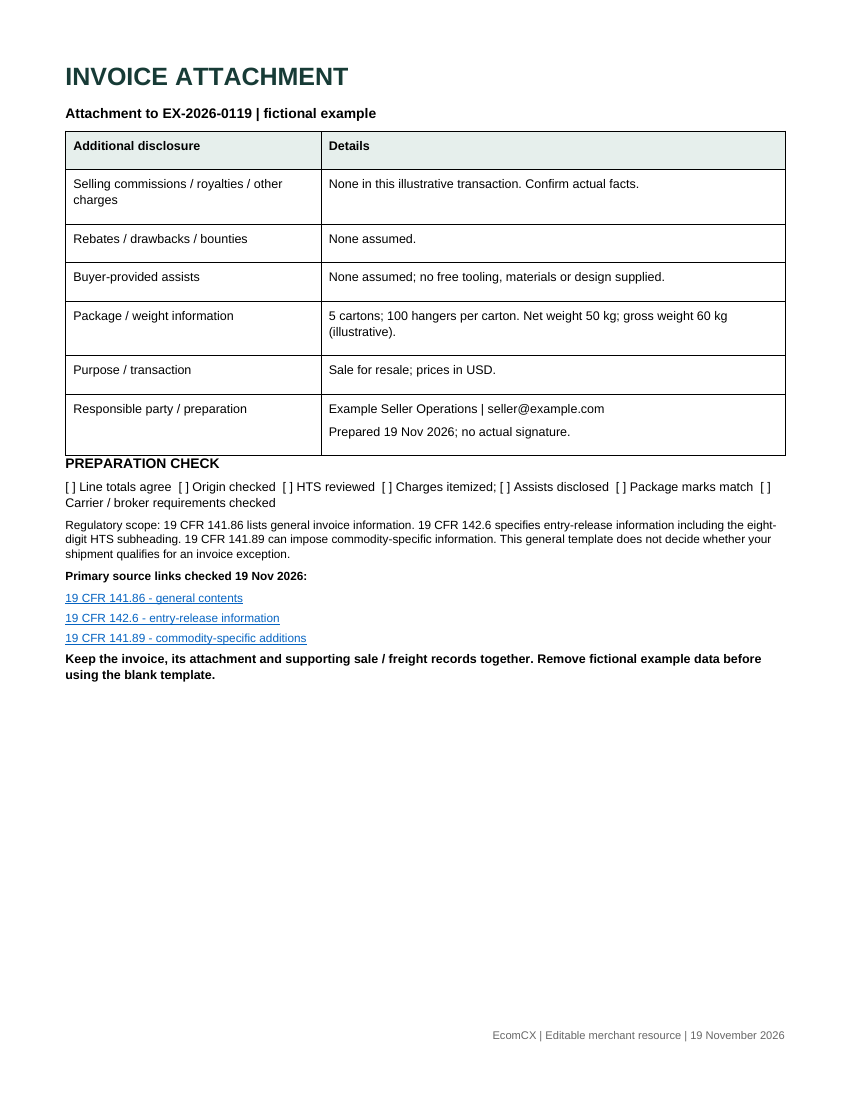
The delivery term is illustrative Free Carrier (FCA) Hanoi, Incoterms 2020. Trade.gov explains that Incoterms allocate responsibilities, costs, and risks; they do not replace the entire sale contract or set payment timing. Copy the term actually agreed, including its named place and version, rather than adopting this example’s term by habit.
Use the right document for the shipment
A commercial invoice, pro forma invoice, packing slip, and bill of lading can accompany the same broad transaction without being interchangeable. Choose the document from the job it must perform.
| Document | Main job | What this resource does |
|---|---|---|
| Commercial invoice | Record the transaction, merchandise, and related invoice information | Supplies a general preparation form and example |
| Pro forma or substitute invoice | Supply information in a context where that document is appropriate | Explains the distinction; does not decide eligibility |
| Packing slip | Describe the parcel’s contents | Keep it separate from the invoice’s values and disclosures |
| Bill of lading | Record the carrier’s transport arrangement and goods receipt | Use the carrier’s required document or process |
Under 19 CFR 141.83, a commercial invoice is generally required unless an applicable exception applies. The provision describes specified circumstances and substitute documentation. It does not mean a merchant can freely choose whichever form is easiest to complete.
For a sample, return, repair, or non-sale shipment, determine the applicable transaction and documentation treatment first. A zero retail charge does not automatically justify a zero customs value. Send the facts to the importer or broker rather than relabeling an ordinary sale “gift” to bypass missing information.
The shipping software comparison discusses carrier and label decisions. It cannot establish the right import documentation for a particular commodity. Keep software availability separate from the underlying document obligation.
Review exceptions and special merchandise
This is a general merchandise template. 19 CFR 141.89 specifies additional invoice information for particular classes of merchandise. A general form is therefore a starting structure, not evidence that every product-specific requirement has been met.
Before using it, tell the broker or responsible importer what the goods are made of, how they are used, their origin, and any special transaction circumstances. Attach product specifications or supporting records where needed. A precise source document is more useful than a broad assurance that the supplier “exports all the time.”
Keep these open questions visible until someone resolves them:
- Does the commodity need information beyond the general invoice fields?
- Are the seller, manufacturer, consignee, and importer different parties?
- Did the buyer provide tooling, materials, design, or another contribution?
- Are charges included in the unit price or billed separately?
- Has a return, repair, discount, or non-sale movement changed the facts?
The fulfillment responsibility guide can help assign ownership, but the answer should come from the actual shipment facts and relevant requirements. Do not convert unanswered questions into “not applicable” merely to finish a form.
Check the packet before it reaches the broker
Perform one review across the invoice, its attachment, the supplier order, and the package record. Match descriptions and quantities. Confirm that currency labels are consistent, charges have an explained treatment, and the attachment names the same invoice version.
The supplied files use US Letter pages and were exported to PDF for visual inspection. Check your own print preview before using A4 paper or a carrier portal that converts uploads. If the portal accepts structured data instead of this document, transfer the verified information and inspect the resulting submission.
Keep a dated copy of what you sent and the supporting quote or sale record. When the shipment changes, revise the invoice consistently rather than editing a total in one place and leaving the attachment behind. That same record discipline supports a later landed-cost and pricing review.
Open the editable invoice, replace every prompt, and compare it with the fictional example. Send the completed packet and unresolved shipment questions to the responsible importer or broker before treating it as ready to use.